Mitch's Btown Blog

Bikes, Hikes, Music, Mushrooms

Retired boomer, out to walk my dogs, ride my bike, and hike the forest paths around Monroe County Indiana. Recently found ADHD runs in my family, and apparently gallops in me…

  • Sometimes it is good to know the law, a bit safer that way!

    IC Title 9 Chapter 11 Indiana Bike Codes

    IC Title 9 Chapter 17 Indiana Pedestrian Codes

    Bicycle Universe Plain language overview

    Here are few quotes from elsewhere in IC (Indiana Code) that I find interesting:

    Indiana Code > Title 9 > Article 21 > Chapter 11

    IC 9-13-2-167 “Sidewalk”
    Sec. 167. “Sidewalk” means the part of a street between the curb lines, or the lateral lines of a roadway, and the adjacent property lines intended for the use of pedestrians.

    IC 9-13-2-182 “Traffic”
    Sec. 182. “Traffic” means pedestrians, ridden or herded animals, vehicles, and other conveyances either singly or together while using any highway for purposes of travel.

    IC 9-21-3-0.5 “Pedestrian hybrid beacon”
    Sec. 0.5. As used in this chapter, “pedestrian hybrid beacon” means a traffic control signal used to warn and control traffic in order to assist pedestrians in crossing a roadway at a crosswalk distinctly indicated for pedestrian crossing by lines or other markings.

    (B) Vehicular traffic, including vehicles turning right or left, shall yield the right-of-way to other vehicles and to pedestrians lawfully within the intersection or an adjacent sidewalk at the time the signal is exhibited.

    IC 9-21-8-20 Pedestrians, bicycles, and other nonmotorized traffic; prohibition on use of highways
    Sec. 20. The Indiana department of transportation may by resolution or order entered in its minutes, and local authorities may by ordinance, with respect to any freeway or interstate highway system under their respective jurisdictions, prohibit the use of a highway by pedestrians, bicycles, or other nonmotorized traffic or by a person operating a motor driven cycle. The Indiana department of transportation or the local authority adopting a prohibiting regulation shall erect and maintain official signs on the freeway or interstate highway system on which the regulations are applicable. If signs are erected, a person may not disobey the restrictions stated on the signs.

    IC 9-21-8-24 Slowing down, turning from a direct course, and changing lanes; performance with reasonable safety; signal
    Sec. 24. A person may not:

    (1) slow down or stop a vehicle;

    (2) turn a vehicle from a direct course upon a highway; or

    (3) change from one (1) traffic lane to another;

    unless the movement can be made with reasonable safety. Before making a movement described in this section, a person shall give a clearly audible signal by sounding the horn if any pedestrian may be affected by the movement and give an appropriate stop or turn signal in the manner provided in sections 27 through 28 of this chapter if any other vehicle may be affected by the movement.

    IC 9-21-8-33 Yield signs; collision with pedestrian or vehicle
    Sec. 33. (a) A person who drives a vehicle approaching a yield sign shall slow down to a speed reasonable for the existing conditions or stop if necessary. The person shall yield the right-of-way to a pedestrian legally crossing the roadway and to a vehicle in the intersection or approaching on another highway so closely as to present an immediate hazard. After yielding, the person may proceed, and all other vehicles approaching the intersection shall yield to the vehicle proceeding.

     (b) If a person who drives a vehicle is involved in a collision with a pedestrian in a crosswalk or a vehicle in the intersection after driving past a yield sign without stopping, the collision is considered prima facie evidence of the person's failure to yield the right-of-way.

    IC 9-21-8-36 Traffic control signals not in operation
    Sec. 36. Except as provided in IC 9-21-17-8 and IC 9-21-3-7(b)(4)(C), when traffic control signals are not in place or not in operation, a person who drives a vehicle shall yield the right-of-way, slowing down or stopping if necessary to yield, to a pedestrian crossing the roadway within a crosswalk when the pedestrian is upon the half of the roadway upon which the vehicle is traveling or when the pedestrian is approaching closely from the opposite half of the roadway.

    IC 9-21-8-37 Pedestrians and children; due care; caution
    Sec. 37. Notwithstanding other provisions of this article or a local ordinance, a person who drives a vehicle shall do the following:

    (1) Exercise due care to avoid colliding with a pedestrian or a person propelling a human powered vehicle, giving an audible signal when necessary.

    (2) Exercise proper caution upon observing a child or an obviously confused, incapacitated, or intoxicated person.
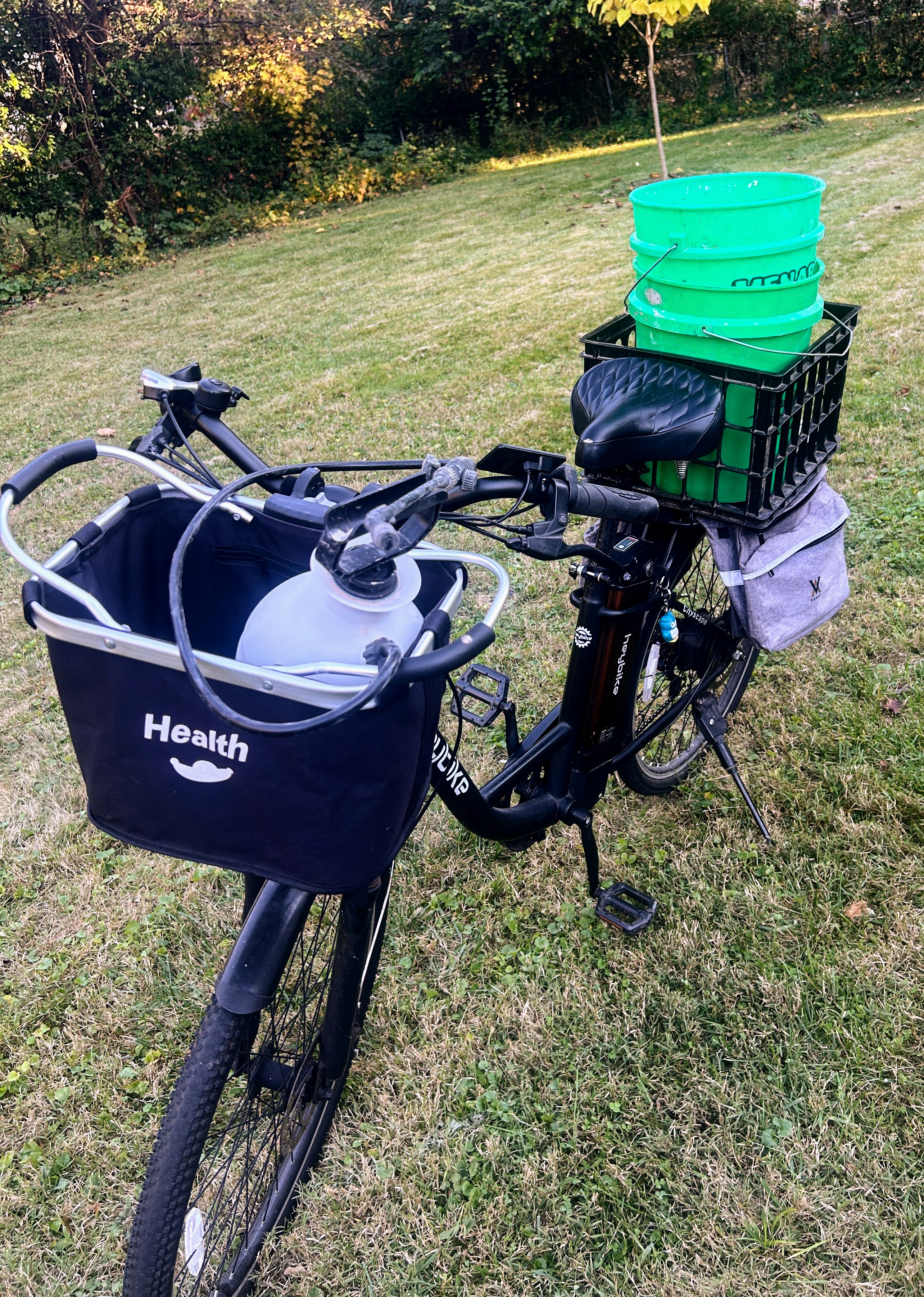
  • So some folks wonder about the cargo ebike catagory “Why would you need such a big bike?” Well, besides hauling two kids and a dog across town, yesterday my RadWagon carted a pair of 40 pound bags of compost, a Bee Balm plant, and some tools from Bloomington Hardware, no problem!

    Mitch’s Workhorse

    But wait there’s more! Check out this journal article titled: “The impact of cargo bikes on the travel patterns of women”. Quite the interesting read, and , to andecdotally support this article, the majority of cargo ebikes that have come through our shop are owned by women (mothers). Looking for practical, efficient, fun, and cost effective ways to get family chores accomplished? Ask a mom!

    Moms know!
    That’s the baby wrapped up in back!

    The carg0-ebike catagory is surging across the country as more and more folks are realizing the utility of an inexpensive, almost carbon-neutral transportation mode that is both more fun and faster for most of our day to day trips. No special clothes, shoes or accessories needed, and you arrive cool and collected at your destination.

    Cargo ebikes start at $2000, but count on wanting a few accessories like paniers, kid rails, and baskets, and maybe some extra lights.

    If you are willing to pay more (it is a lot cheaper than a car…), then Yuba, Tern , Urban Arrow are great brands, and will last for years and years. Clever Cycles in Portland, Oregon, has a selection of both front loading (bucket) and rear extenstion models by the traditional cargo bike brands Tern, Yuba, and Urban Arrow, with a price range of $3000-$9000.

    RadWagon 4 $2000
    They certainly have a good build, and years of experience building cargo ebikes. (Disclaimer: I own a 2018 Radwagon, and after 5000 miles of mostly city riding, I still love its utility.)

    RadWagon 4, 22″ wheels

    Blix Packa $2000
    Slick Design, 24″ wheel, hydraulic brakes 12 Ah battery (2nd battery option

    Blix Packa 24″ wheel

    Himiway Big Dog $2000
    Fat tire workhorse, 20″x 4″ tires, 2nd level componants, 400# capacity, shorter frame than most.

    Big Dog

    KBO $1800
    Wadda Deal! 15 Ah, 20″ wheel, 750W motor, 400#, I have not seen one yet, but it looks great online.

    KBO Cargo

    Eunorau MAX-CARGO ~$2000 (Depends on battery choices)

    Eunorau Max Cargo

    Biktrix Skycap $2400
    This one costs just a bit more, is very customizable, with powerful battery options

    Biktrix Skycap

    Yuba Mundo E8 $4800
    Expensive, but worth it. Mid drive motor and a whopping 550# capacity, Yuba has been a leader in cargo bikes for years, with full range of family accessories. Available in Bloomington from Revolution Bike and Bean.

    Yuba Mundo E8

    Tern GSD S00 LX $6800
    Truly Expensive, all top line componants and design

  • It was the early 80’s when I first heard this song while standing on the north side of the Bloomington square. Bob Lucas played this circle of fifths novelty, almost Dadaist, tune from 1928 (lyrics by Mort Dixon). He played lightening fast and sang the nonsense lyrics, boy was I impressed! I was aware of the jazzy chord changes from playing jug band tunes like “Keep on Trucking”, but this was a chord per measure, fast, dynamic, and fun!

    We were touring the antique mall after the Farmers’ Market yesterday, and Dexter found the guitars, and June recorded as I made a withdrawal from the memory bank…

  • Here is my musical reaction to our No Kings rally in Bloomington, written by Tom Paxton and Cathy Fink!

  • I love hiking, and a major driver of my wanderings has been finding rare, common, toxic, medicinal, edible, beautiful, and phantasmic fungi of all shapes and sizes, in our Hoosier Forests. I’ve not yet combed through this collection, this is the raw data of my explorations.

    Mitch’s Fungi Photos

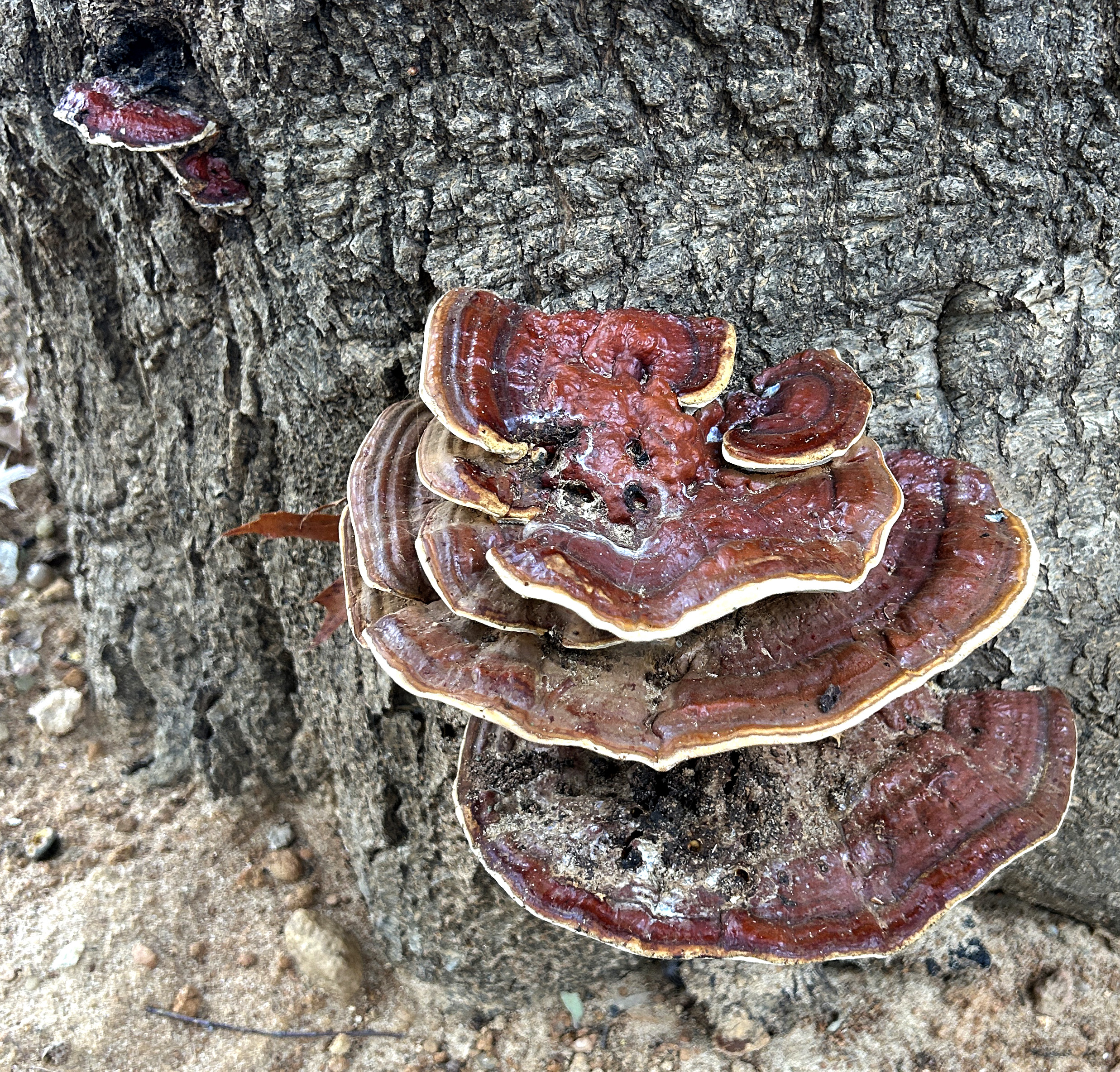
    This picture is a specimen of Ganoderma sessile that I found at the base of a sweet gum tree at the corner of 6th and Dunn here in Bloomington. It has most of the same polysaccarides as its cousin Ganoderma lucidium, aka Lingzhi/Reishi.

  • Here is a repost of my 2022 take on the exercise (measure in METs) and ebikes ebikes:

    It seems a bit counter intuitive, but riding an ebike is as good exercise as riding a conventional bike! Yes, you may exert less power while riding, but a study in ScienceDirect and a follow-up Norwegian study show that ebike riders put on more miles, and thus end up getting as much physical activity, measured in Metabolic Equivalent Tasks (MET), as conventional bike riders.

    Here is an article from a dedicated bike rider who tracked his activity ebike activity vs. his analog bike, quite detailed and interesting

    This image has an empty alt attribute; its file name is 58015-science-direct.png

    Highlights:

    • Ebikers take longer trips by ebike and bicycle, compared to cyclists.
    • Physical activity gains from active travel are similar in e-bikers and cyclists.
    • Substituting all car trips with ebike use leads to a gain of 550 MET min/week.
    • Transport mode substituted by the ebike is still used frequently afterwards.

    I’m not sure what will actually happen, but I am certain that e-bikes are one of the steps towards a better, more humane transportation system.

  • I’ve been working on playing some old guy songs on my tenor guitar, and I remembered this tune, I think I first heard it when Iris Dement came to Bloomington in the 90’s. I liked that the lyrics create an image of an afterlife that comports both with bibilical images as well as my athiest/spiritualist/hopeful perception of a multidimensional universe that is welcoming, abundant, and spacious.

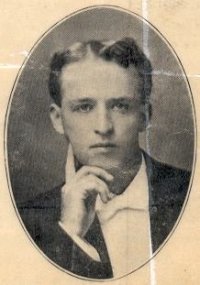
    Herbert Buffum

    The tune was written by 1930 by Herbert Buffum, an Illinois born Ho­li­ness Pen­te­cost­al evan­gel­ist and gospel songwriter, with over 1000 published songs (while he may have written 10,000 total.) His L.A. Times obituary called him “The King of Gos­pel Song Writ­ers”. He used Biblical images extensively, and in this tune, he refers to the biblical Foursquare City (a term used for the tabernacle in the Book of Exodus, of the Temple of the Lord in the book of Ezekiel, and of Heaven as described in the book of the Revelation.)

    It was first recorded in 1930 by the Vaughan Happy Two, but did not become a hit until it was recorded later that year by Rev. F.W. McGee. McGee’s recording is upbeat, rhythmic (with intense backbeat clapping), dual lead vocals, jazz instrumentation, and gospel intensity. Sara Carter said she heard it while visiting L.A. (home to both Baffum and McGee) in the late 30’s, and adapted it for the Carter family’s last recording session in 1941. Most other versions came from this recording, with the exception of Turk Murphy & His Jazz Band and Hank Locklin & His Rocky Mountain Playboys, (see below for details and recordings.)

    The Carter Family seems to have dropped the II chord in their version, and slowed it down, making it perhaps more country? They also rewrote the second verse, incorporating the tercet: “Into that city fair, With fifty miles of elbow room, On either side to spare”, and reprising the line “Where the flowers ever bloom” as “Where the fairest flowers bloom”. But the rest is Sara Carter’s folk process.

    Here is a well writen post about Rev. F.W. McGee, the details about 50 Miles are in the 2nd half of the piece, with links to quite a few recordings of the tune. Here is a more comprehensive (20 items) list of recordings of the song, once you get past the ads: https://secondhandsongs.com/work/137802/all

    CARTER 2nd Verse

    Sometimes I’m cramped and I’m crowded here
    And I long for elbow room
    Now I long to reach for altitude
    Where the fairest flowers bloom
    It won’t be long before I pass
    Into that city fair
    With fifty miles of elbow room
    On either side to spare

  • Take Me to the Land of Jazz – Columbia 15367
    AKA, Take Me to the Intersection of Old Time and Jazz
    Original Sheet Music

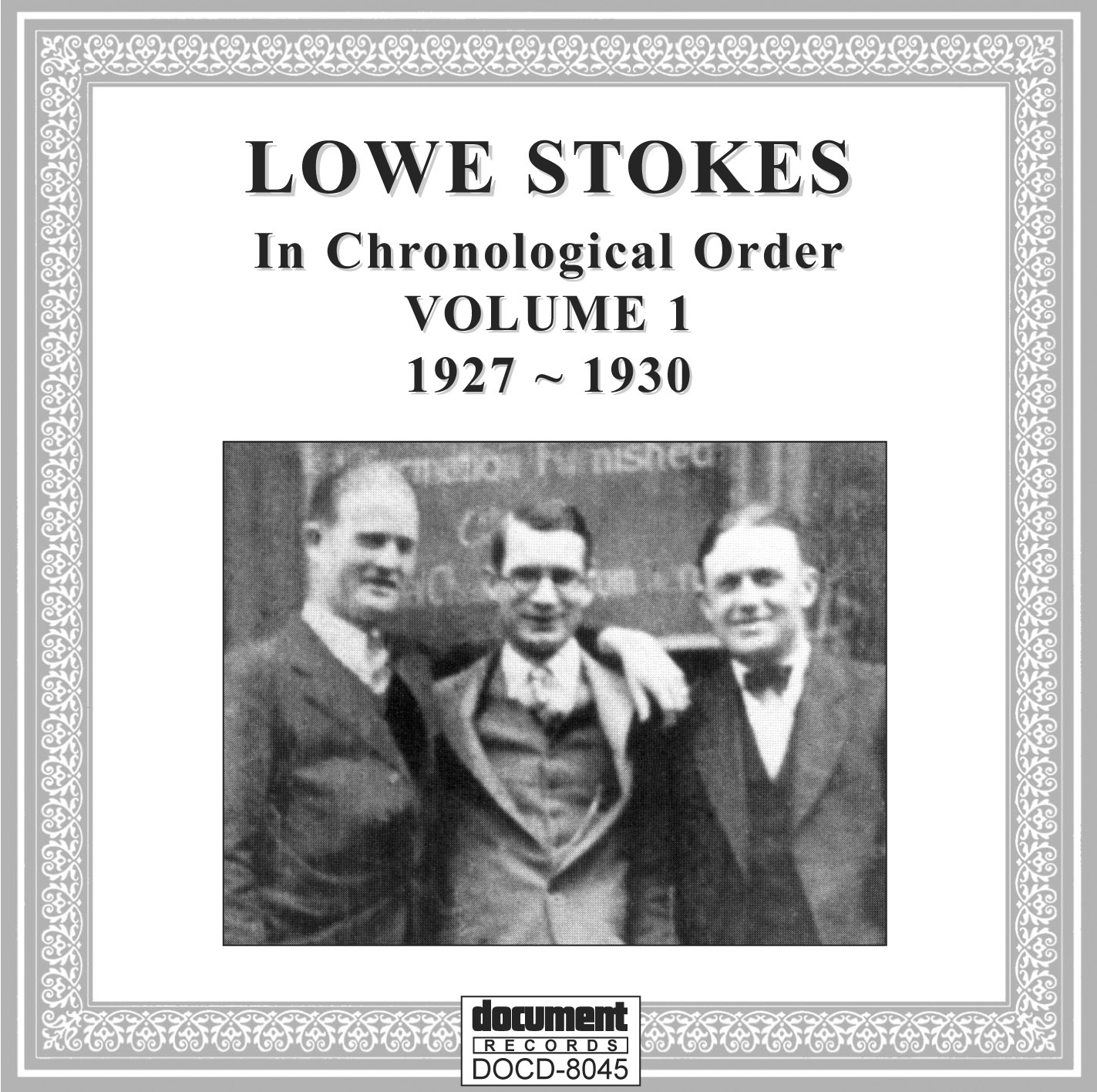
    I had been listening to Lowe Stokes for years, as a fiddler in the Skillet Lickers recordings, before I found this 1928 recording of Stokes and his band the North Georgians. In this tune, and several others, they combined their old time fiddle band line up with distinctly jazz/blues tunes and instruments (as did Jimmy Rodgers, who recorded with Louis Armstrong in 1930).

    This recording includes a guitar solo break, apparently the first ever recorded, played by either Hoke Rice (Stokes’ regular guitarist at the time) or Perry Bechtel, who went on to a career in jazz, playing guitar and plectrum banjo. I am leaning towards Bechtel as the guitarist on this recording, his jazzy style seems much more like him than Rice, who was more in the Riley Puckett/North Georgia bass run style of playing. In 1929 he recorded over a dozen tunes in his own name, and most of them fall into the Jimmy Rodgers tribute/imitation style. Still Hoke displayed a jazzy side, including clarinet and a jazzy guitar break on his version of Georgia Jubilee. Well done cousin, but it just does not seem up to the playing on Land of Jazz, plus the guitar itself sounds so different than on the Land of Jazz.

    The 1919 sheet music is keyed in Bb, but the first two recordings, by Marion Harris and Billy Murray (both 1919) were sung in E, both had the ragtime feel, as does this recent version by the Peachtime Ragtime Society Orchestra in Eb. The Lowe Stokes version is in F, showing some level of expertise on both fiddle and guitar. While a standard jazz key, F is somewhat uncommon for country fiddle, though not as uncommon as Bb! [The one tune So I still vote for Bechtel!]

    Here is some biographic information on Lowe Stokes from Document Records, they have a great catalog!

    Lowe Stokes may be best known for his fiddling skills as a member of Gid Tanner and His Skillet Lickers, after he joined the hillbilly supergroup in 1927.

    Stokes was a bit of a rabble-rouser and ended up in some sticky situations – like the time his bow hand was pretty much shot off in the heat of an argument with a still operator. Losing a hand might seem like a pretty serious fiddling handicap, but frequent fellow Skillet Licker Bert Layne was a shade-tree mechanic and reportedly crafted a temporary hook device (as seen in the picture) so Stokes could keep on fiddlin’. Later photos indicate that he likely had a prosthetic hand fitted to hold the bow. Lowe Stokes was shot at least twice and stabbed once in his touring days, and Layne said that he learned to use that hook like a weapon.

    Lowe Stokes with prosthetic arm

    Like fellow Skillet Licker fiddler Clayton McMichen, Stokes’ side projects and musical tastes tended to drift into the realm of string jazz, in what might be described as a hillbilly take on the music of 1920-30’s jazz greats Joe Venuti and Eddie Lang. In October 1928, Lowe Stokes and His North Georgians recorded the quite remarkable “Take Me to the Land of Jazz.” Some sources speculate that the guitar solo belongs to 1920’s Atlanta-based jazz guitarist Perry Bechtel, but others say the improv picking belongs to one of country music’s first flat-pickers, Hoke Rice, especially since he recorded and played with Stokes before and after this session. Either way, the recording is proof that some of the 1920’s Georgia hillbilly acts had much wider musical tastes and skills than commonly known.

    If you prefer the pure joy of straight-up hillbilly fiddle novelty tunes, the North Georgians’ “Wish I Had Stayed in the Wagon Yard,” recorded in Atlanta in November 1929, is about as fun as it gets. [Both tracks are available in the Document Records Store for individual digital download and on Document CD 8045]

    The recording operations like the Skillet Lickers and the other old time groups were “the side” operations for these musicians, recording units that never ever played anywhere together but the recoirding studios, playing music that the recording industry saw as old time music when each really yearned, especially McMichen really were doing the “old time music” for the money and to answer the dictates of the recording studio, and wished to play more jazz and pop oriented music if they had the chance. It is quite important to realize how many of these bands were purely studio recording bands who never played outside the recording studio and played different music when they had the chance or when they were not in the studio.

    Lowe Stokes

    It is pretty much the opposite of the general assumption, the recording studios wanted what they saw as “old time” as opposed to the more pop oriented or jazz influenced music many of these folks especially the younger ones wanted to play, or saw as the avenue for them, So many of them in fact had fairly “progressive” aspirations and feel about the music they made which conflicted with the record company people from totally outside the music world they lived in who wanted “product” that they could market as old time.

    Chattanooga News (where Lowe lived) reported that Lowe’s hand was mistaking shot off while on a hunting trip with his brother on Christmas day down in Cartesville, GA. News also stated that a Boyd Chapman, a local mechanic rigged up the “contraption” in the pic so he could fiddle in a May 1931 fiddlers contest in Chattanooga.

    ********************

    So, whaddya think? Hoke or Perry?

  • Since all the local beaches are closed (except Riddle Point!), this has been our goto cool off spot. In July we were able to jump off tree branches into the water, now they are too high to reach.

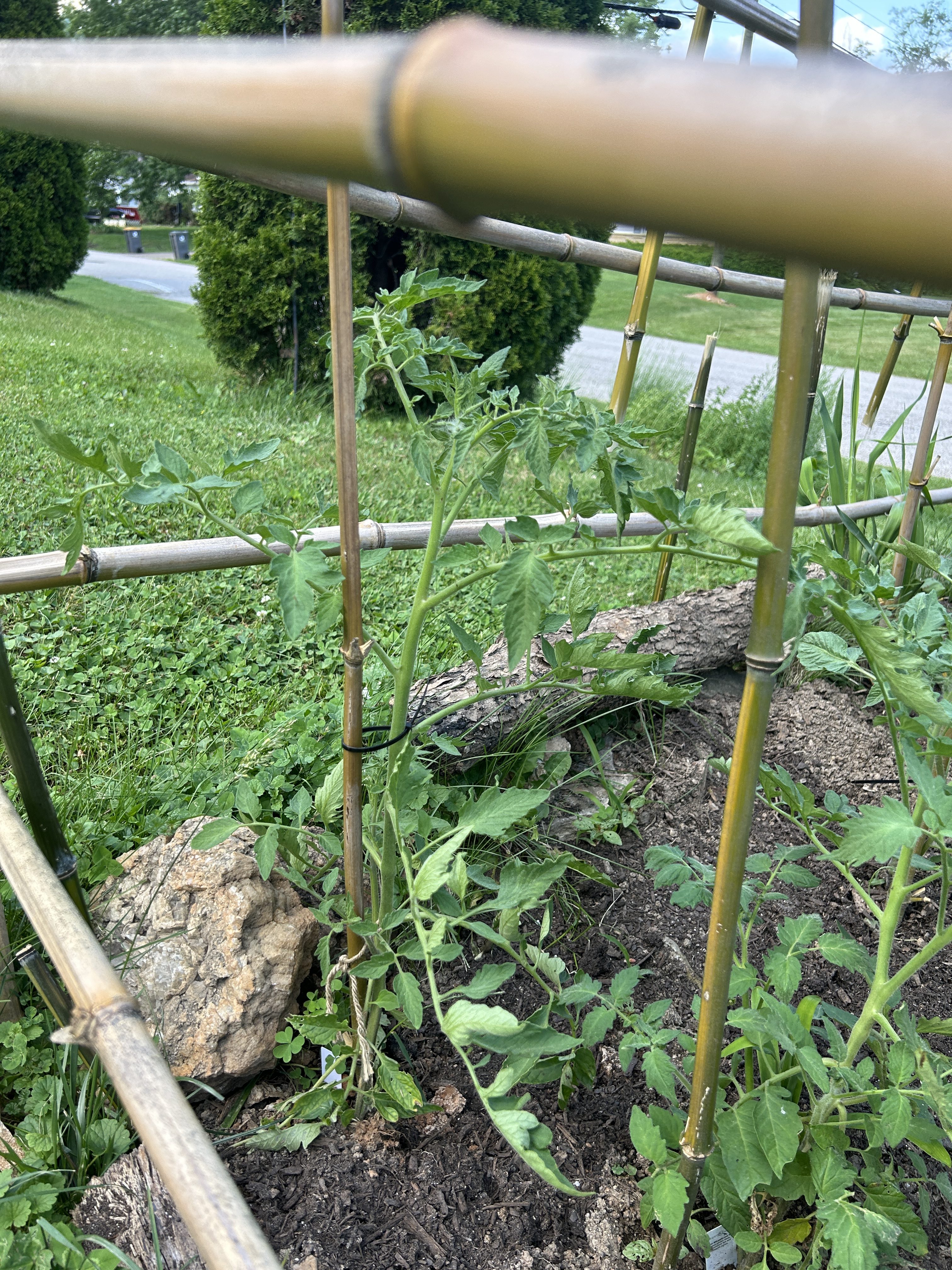
  • Last year I planted my first Tangerine tomatoes, which have been shown to have cis-lycopene its most bio-available form, in much higher proportions than in red tomatoes. (Our bodies transform the more common trans-lycopene into cic-lycopene before it is used.) This means our bodies can use more of the anti-oxident effect, and thus be more protective against heart disease, cancer, and other metabolic ailments. Here is what the NIH says about lycopene:

    “Lycopene, belonging to the carotenoids, is a tetraterpene compound abundantly found in tomato and tomato-based products. It is fundamentally recognized as a potent antioxidant and a non-pro-vitamin A carotenoid. Lycopene has been found to be efficient in ameliorating cancer insurgences, diabetes mellitus, cardiac complications, oxidative stress-mediated malfunctions, inflammatory events, skin and bone diseases, hepatic, neural and reproductive disorders. ” Link

    Jami provided these links to NIH articles, and an as well as one from Nature. It seems that eating them fresh is the best bet when needing a therapeautic dose heating reduces the amount of available lycopene To quote Jami on this: “Tangerine tomatoes can be considered a ‘Functional Food,’ a food that offer’s health benefits beyond their nutritional value.”

    Tangerine tomatoes increase total and tetra-cis-lycopene isomer concentrations more than red tomatoes in healthy adult humans

    Tangerine tomatoes: origin, biochemistry, potential health benefits and future prospects

    Enhanced bioavailability of lycopene when consumed as cis-isomers from tangerine compared to red tomato juice, a randomized, cross-over clinical trial

    Thermal processing differentially affects lycopene and other carotenoids in cis-lycopene containing, tangerine tomatoes

    Tomatoes protect against development of UV-induced keratinocyte carcinoma via metabolomic alterations